Industries/Software and apps
For the spreadsheet that is quietly running the business.
Three people arrive here. The company where one Google Sheet is load bearing and somebody just overwrote a column. The service business losing an hour a day to people asking where their thing is. And the founder who needs something real to put in front of an investor.
All three are buying the same thing. One workflow built properly, with roles and permissions that hold, and a login that does what a login is supposed to do.
What you get
What is in the build, and what is not.
In the build
- One workflow built properly, with roles and permissions that hold, scoped to a fixed number.
- Login, invitations, an admin view and two integrations, on accounts in your name.
- Backups you have seen restored, error monitoring and a runbook, so it keeps working after we leave.
And underneath that
- Discovery, credited against the build if we get the go-ahead within 60 days. A flow list, a data model with the hard decisions made, the named integrations, a screen inventory, and a fixed quote with the schedule and the risks written down.
- One core workflow built properly, plus the screens around it, up to fourteen named in the contract.
- Two roles, with the permission checks on the server where they cannot be clicked past.
- Login. Email plus one social, password reset, email verification, invitations.
- An admin view to read things and fix them.
- Two named third party integrations.
- Empty, loading, error and permission denied states designed on every screen.
- Email from your own sending subdomain, with the DNS records set up.
- Error monitoring wired and tested, and rate limiting on anything open to the public.
- Backups configured, and one restore actually performed and written down.
- Works on a phone browser, and installs to the home screen where that is useful.
- Analytics with an event plan for the three actions that matter.
- An accounts register, a written runbook, and a recorded walkthrough of the admin view.
- Thirty days of warranty against the approved spec.
Not in the build
None of this is a no. Each one is a separate line, and we price it when you ask.
- Other companies each having their own private version, separate from yours.
- Subscription billing. Trials, proration, dunning, cancellations, coupons.
- Single sign on.
- Live updates between people, chat, or two people editing the same thing at once.
- A listing in the App Store or Play Store.
- Migrating or cleaning up your existing data.
- More than two integrations.
- Working offline.
- Reporting and dashboards beyond one export.
- Compliance work, audit logging, penetration testing, or any certification.
- Copy, photography, or brand identity.
- A guarantee that it will never go down. We commit to a response time instead, which is a promise we can keep.
- Support after the thirty day warranty. That is a monthly plan, and we quote it with the build.
How this one works
What is different about software.
01
We scope it in flows and roles, not pages
You get a fixed number that means something. We scope in flows and roles rather than pages, because a second role touches every screen you already built. Discovery ends with a flow list, a data model with the hard decisions made, the named integrations, a screen inventory, and a fixed quote with the schedule and the risks written down, and that document is what the build gets measured against. If something new turns up later, it is priced as a flow, and the reason is visible in that document.
02
The developer accounts are yours, in your name
Your app stays yours. If this ends up in the App Store, the Apple and Google accounts are opened on your card, in your company's name, and we get added to them. An app published under somebody else's account is an app you cannot take with you, and moving it later is a support ticket nobody wants to file.
Questions
Asked on every call.
Can it be in the App Store?+
It can. The question is whether it should. Apple rejects apps that are a website in a wrapper, so a listing has to earn itself with something a browser genuinely cannot do. Push that actually arrives, working offline, the camera, a face or fingerprint unlock, a widget. If we have one of those, we price the store release as its own line, because it is setup, screenshots, privacy labels, review cycles and at least one rejection built into the schedule. If we do not, we build it so it installs to the home screen from the browser and behaves like an app.
What happens when it breaks?+
Two different things, priced differently. For the first thirty days after launch, anything that does not do what the approved spec says it does, we fix, at no charge. That is a warranty, and it covers bugs rather than new ideas. After that it is a plan, and the plan is what pays for us to be reachable. What you get is a response time, not a promise that nothing will ever go down, because that is a promise nobody can keep.
Who owns the code?+
You own everything specific to you. The code that runs your business, the design, the data, all assigned to you when the final invoice clears. The one thing we keep is our own reusable library, the generic pieces we bring to every project, and you get a permanent licence to use it in this. The repository lives in your GitHub from the first commit, not ours.
Can we add users later?+
Depends which kind, and the two are not the same job. More people at your company logging in is what we are building, and adding one is a screen the admin already has. Other companies each having their own private version, with their own people who cannot see each other's data, is a different way of building the database. Adding that later means rebuilding rather than adding. So tell us in discovery, even if it is two years out. If it is on the table, the data model is built for it from the first table, and the fixed quote says so.
The demos
Two real ones to click through.
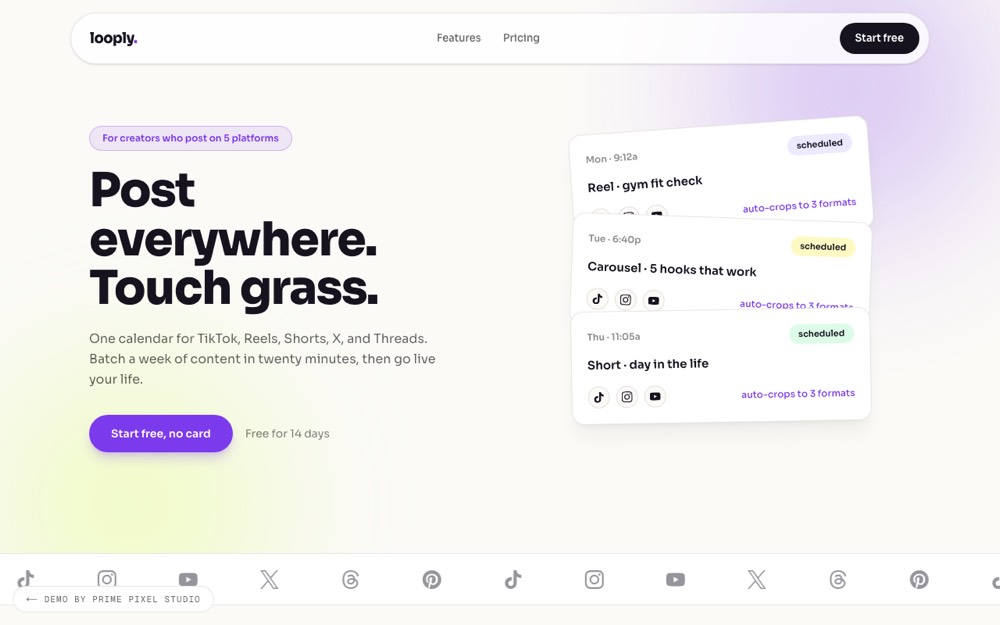
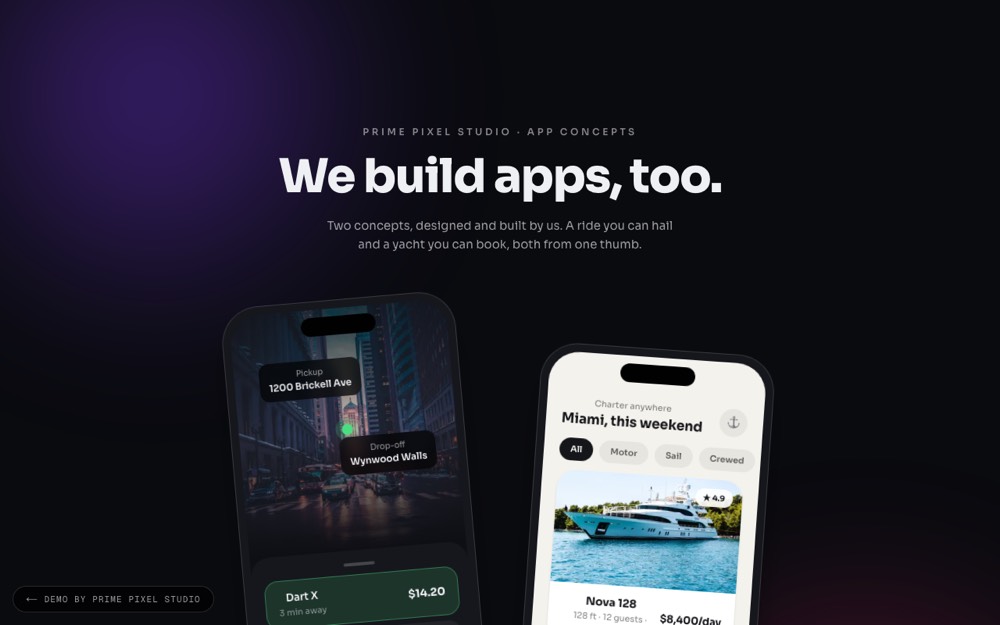
Built by us, running live, and every button in them goes somewhere. Pick a plan on looply and finish the signup, then request a ride on DART and wait for the driver. The demos show a product signup and two consumer app flows. Portals and internal tools live behind a login for one company, which is why there is no public demo of one yet. Yours will not look like either one. They are here to show what finished looks like, not to be templates.
Tell us about yours.
Two minutes on the form, then a short call. We reply within 24 to 48 hours, and the form opens with SaaS already selected.
Rather just email us? info@primepixelstudio.co